


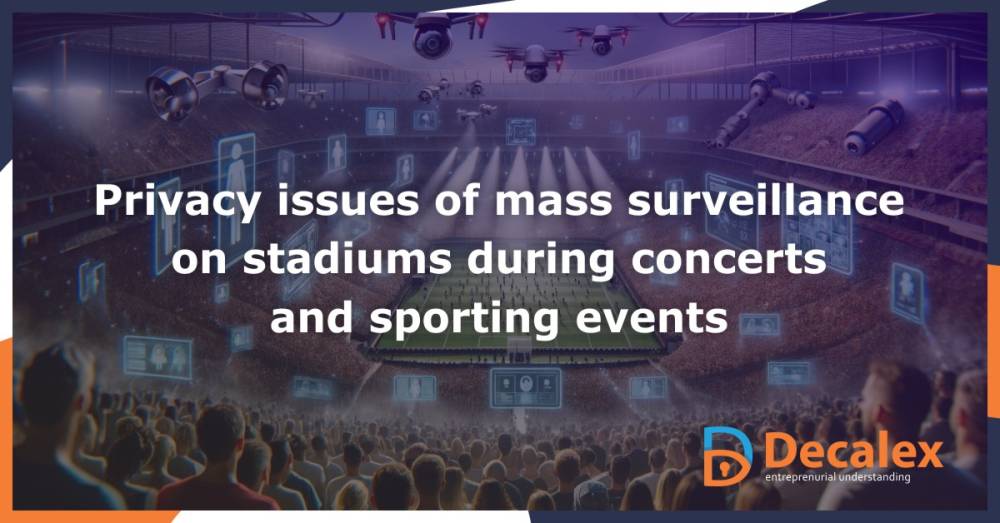
The summer of 2024 brought some of the biggest sports events — UEFA Champions League final, Olympic Games, UEFA Euro 2024, Copa America. Most of these competitions use surveillance technologies. This article examines the GDPR framework for mass surveillance at public events and the limits on acceptable monitoring.
The summer of 2024 brings some of the biggest sports events, including the UEFA Champions League final, the Olympic Games, UEFA Euro 2024, Copa America. Most of these competitions will take place in Europe, on stadiums where thousands of people will be watching live. Given the technological advances in AI and other technologies, we expect to see increased security measures through new mass monitoring tools. Another reason for increased security measures may be the increasing number of incidents at stadiums, especially football competitions, and the problems caused by the use of QR code tickets, which can easily be forged. Such incidents have created problems at the highest level matches, such as the Champions League final in Paris in 2022, as well as Romanian championship matches.
Under these circumstances, the French authorities are advocating for the adoption of a law to introduce the use of AI technology in the process of monitoring crowds in stadiums. In the following we will see, how access to stadiums is done today, what will be the role of AI in monitoring, what are the reasons leading to such strict monitoring, and what risks such monitoring poses to citizens.
How is the stadium access made?
Access to stadiums, whether it is a sporting event or a concert/festival, is a strict one, with many security measures, comparable to airport access. For example, at a Romanian championship football match, access is made as follows:
· People who have a ticket for the match pass through an initial filter, but do not have any prohibited bulky objects (e.g. a bottle of water) with them.
· A second filter, in which a more thorough body search is carried out than the first, where all the prohibited objects are identified (which will be stored and later claimed by the spectators – this is the rule established by law, in reality the objects are thrown on the ground and never recovered, often even consisting of coins)
· A third filter, this time without human intervention, where the entry ticket is scanned
At higher risk competitions, additional security filters may be required, but the situation exemplified represents the industry standard.
Risks differ depending on the event, but we can identify some risks that occur almost all the time:
· Entering the event without a valid ticket
· Introducing prohibited substances
· Introducing alcoholic beverages (in the case of football matches, as it can lead to aggressive behaviour by hooligans – there are European countries that allow the sale of alcoholic beverages at football matches)
· Introducing weapons
· Introducing pyrotechnic materials (a criminal offence in Romania)
· Access with any objects that can be thrown on the playing surface and may pose a danger to the athletes (e.g. a lighter, a lipstick, a bottle of water)
These globally common practices have emerged over decades of unfortunate events leading to serious accidents resulting in fatalities, such as the Astroworld festival (which resulted in 10 deaths and hundreds of injuries) or the 1985 Heysel Stadium disaster where Italian fans lost their lives just before the whistle blew in the European Champions Cup final, due to reprehensible incidents caused by Liverpool hooligans (Specifically, in the case of the Juventus-Liverpool match, fans of the two teams were standing in two adjacent sectors, the result was that English fans threw everything they could get their hands on at the Italian supporters, and when that was no longer enough the English fans broke the security cordon and turned on the Italians. The frightened fans fled to the edge of the sector, where, due to the large number of people concentrated in one place, part of the stadium collapsed under their weight, the consequences of the disaster being impossible to describe in words). Other similar relevant incidents are the Ibrox disaster of 1971 or the Hillsborough disaster.
Can AI improve surveillance?
The potential of Artificial Intelligence (AI) to enhance surveillance capabilities is a topic of growing interest and debate among authorities, technologists, and privacy advocates alike. Proponents of AI-enhanced surveillance systems argue that such technology offers unprecedented efficiency and accuracy in monitoring public spaces, thereby improving security and safety. Through real-time analysis, AI can detect various behaviors and activities, some of which include:
1. Risk of Crowd Crushing: AI algorithms can analyze crowd movements to identify patterns that may lead to dangerous situations, such as stampedes or crushing, allowing for timely interventions.
2. Aggressive Behaviors: By monitoring body language and gestures, AI can pinpoint aggressive or potentially violent actions before they escalate.
3. Environmental Violations: Simple yet impactful, AI can detect when individuals litter, contributing to broader efforts to maintain cleanliness and order.
4. Detecting Brawls and Criminal Activity: From fights to more severe criminal activities, AI systems can alert authorities to incidents as they occur, potentially stopping crimes in progress.
5. Crowd Behavior Analysis: Understanding how crowds move and react in different situations can help in planning public events and emergency evacuations.
6. Unauthorized Entry: AI can monitor and alert on individuals entering restricted or unauthorized areas, enhancing security protocols.
7. Predictive Behavior Analysis: Over time, AI can analyze patterns in human behavior to predict potential incidents before they happen, moving from reactive to proactive surveillance.
8. Integration with Other Systems: By linking with databases and systems such as access control, AI can provide a holistic view of security, combining physical movements with digital records for comprehensive oversight.
However, the deployment of AI in surveillance raises important ethical questions. The technology’s ability to make autonomous decisions based on programmed algorithms brings up concerns about privacy, bias, and accountability. For instance, how does the AI determine what constitutes “abnormal” behavior, and who sets these parameters? The risk of false positives and the implications for individuals mistakenly identified as threats are also significant considerations.
Moreover, the integration of AI surveillance with other systems and databases amplifies these concerns, potentially leading to a surveillance state where individuals are constantly monitored, and their behaviors analyzed without their consent. It challenges the notion of public spaces as free and open, possibly altering how individuals behave when they know they are being watched.
Is there any aplicable legal framework?
As AI continues to evolve and become more sophisticated, it is crucial for discussions around its use in surveillance to include not just the technological capabilities but also the ethical, legal, and social implications. Ensuring transparency, accountability, and public involvement in these conversations is essential to navigating the balance between enhanced security and the preservation of fundamental privacy rights and freedoms.
There is currently no legislative framework regulating this processing, but this has not stopped the authorities of some municipalities in France (e.g. Massy (Essonne) or Aulnay-sous-Bois (Seine-Saint-Denis)) from testing it on their own citizens. This testing of AI monitoring is taking place against the backdrop of a bill in the French Senate, which aims to introduce this technology for monitoring during this year’s Paris Olympics. At the same time, the European Parliament has recently adopted the “EU AI ACT”, a piece of legislation to fill the legislative gap in the field of AI.
At national level, the organisation of sporting events is regulated by Law 4/2008. It contains provisions on video monitoring, but no provisions on artificial intelligence.
In the absence of other specific provisions, for data processing carried out by artificial intelligence, some answers can be found in the GDPR regulation.
The privacy risks of using AI technology
Firstly, the use of such technology presents the risk of violating the right to privacy (provided by Article 8 of the European Convention on Human Rights) due to the intrusive nature of the use of such technology. The use of AI technology in video monitoring is different from the monitoring that has been done so far because of the perpetual nature of the monitoring on the data subject. Until now, monitoring has been done according to the concept of Panopticon (According to this concept, in the middle of a prison there is a tower. In the tower there is a guard, who can see what any prisoner is doing at any time, but he cannot see everyone. The inmates know that the guard can see them at all times, but they do not now know where the guard is looking). This concept is currently practically used in video surveillance, but with the introduction of artificial intelligence, people will be surveilled all the time and their behaviour can be analysed in detail without having a clear limit to this analysis.
Secondly, the analysis of human behaviour, in the form envisaged by experts in the field, presents, from a GDPR perspective, a processing of biometric data. These data constitute sensitive data and more attention must be paid to them, as they cannot be processed anyway. These data can be used to uniquely identify a person, so data anonymisation measures are necessary.
Thirdly, the processing envisaged in this form inherently involves profiling. Article 22 of the GDPR provides that ” The data subject shall have the right not to be subject to a decision based solely on automated processing, including profiling, which produces legal effects concerning him or her or similarly significantly affects him or her”. There is, however, an exception if national law allows this. In practice, this is the role of the draft law in France for the Olympic Games. In Romania, Law 4/2008 currently has no provisions on the use of artificial intelligence.
Last but not least, this processing by AI should be transparent, we should be informed exactly where the data ends up, who has access to it, where it is stored and for what purposes it is used. The opacity sometimes shown by the authorities represents a greater threat to citizens in terms of data protection than the dangers of not utilisng these technologies could be.
The use of these technologies leads to what is called the smart city concept. This concept refers to the continuous monitoring of people, who are subject to automated decisions made by algorithms based on their actions. The smart city concept will have to answer questions such as how it manages to respect citizens’ rights to their personal lives, how it ensures the security of their data, and how it prevents the misuse of monitoring (so that we do not move towards a totalitarian society). In other words, the smart city concept must respect the principles of a democracy, and not lead us towards an ‘algocracy’ (i.e. a society based on decisions made by algorithms).
Mihai Florea
Data protection trainee
Decalex Digital SRL
Understanding the relevant risks, responsibilities, and objectives provides the necessary perspective for setting priorities and strengthening organizational resilience
Understanding the implications for activities, processes, responsibilities, organizational objectives, and decisions is the foundation of an informed and sustainable approach.
Effective risk management requires clear responsibilities, appropriate processes, and monitoring mechanisms that are commensurate with the level of exposure.
Clear roles and coordination mechanisms contribute to the coherence and sustainability of decisions.
Regular assessments of processes, responsibilities, and control mechanisms provide the necessary foundation for strengthening organizational resilience and governance.